

Prepositions
Prepositions
Words that tell you where something is.
- Mastered by
- ASHA places inside, on and under in the 3-to-4-year band, and behind, beside and between in the 4-to-5-year band
- Practice items
- 51
- Sections
- 5
Play it
Each one opens full screen, already set to this skill.
What this skill is
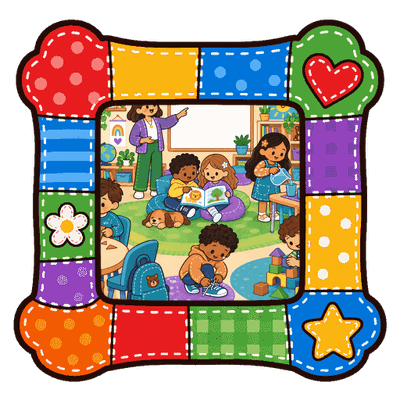
Prepositions are small words that carry a lot of weight - they tell you where something is, when it happened, or how it relates to something else. Spatial prepositions come first and in a fairly predictable order. "In" and "on" are early because containers and surfaces are concrete. "Between" and "in front of" come much later because they require holding two reference points in mind at once.
What to expect
By 2;6 most children understand "in" and "on" even if they cannot say them. By 3;6 add "under," "out of," and "off." Around 4;6 come "behind," "in front of," "next to," and "between." "Above," "below," "around," and "through" round things out by about 5;6. Understanding always runs ahead of use.
Try this at home
When to refer
Put it into practice
Tap any item below to open it full screen, one at a time, so a child can answer without reading the answer first.
These activities are a starting point, not the practice itself. A structured task is a good way to introduce a form and to find out whether a child has it yet. What actually moves it into everyday speech is using it in the real world and in ordinary play — which means the four things below matter more than finishing the list.
Recast
Say their sentence back correctly, without asking them to repeat it. Child: “he goed.” You: “he went! Where did he go?”
Expand
Add one or two words to what they said and hand it back. Child: “big truck.” You: “a big red truck!”
Simplify what you ask
Cut a long instruction into single steps and say them in the order they happen, rather than repeating the long one louder.
Follow their lead
Use whatever they are already playing with. A form practiced on something they chose is the one that shows up again tomorrow.
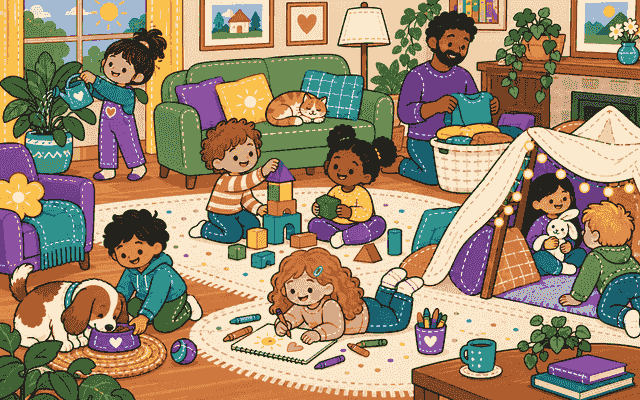
Early Prepositions: In, On, Under, Out
10 itemsLook at the picture and fill in the blank. Tap any item to open it full screen.
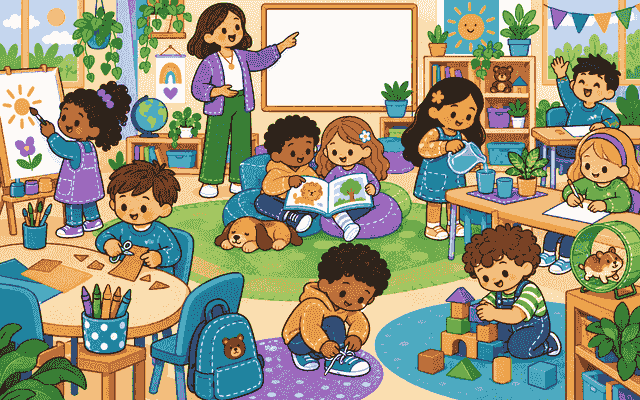
Later Prepositions: Behind, In Front Of, Next To, Between
10 itemsLook at the picture and fill in the blank. Tap any item to open it full screen.
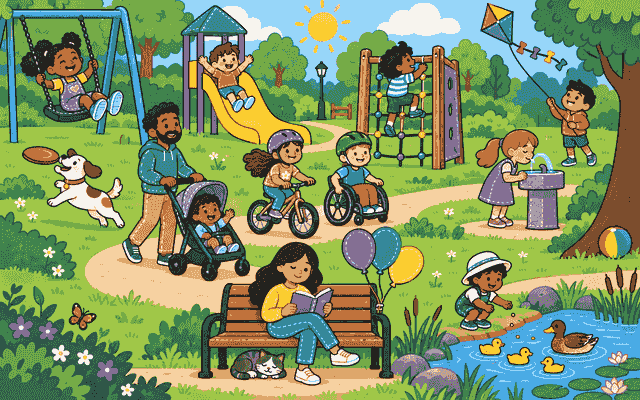
Advanced Prepositions: Above, Below, Through, Around, Across
10 itemsLook at the picture and fill in the blank. Tap any item to open it full screen.
Where Is Teddy?
13 itemsLook at the picture. Where is Teddy? Fill in the blank. Tap any item to open it full screen.
Follow the Direction
8 itemsGive the child a small toy and a box. Read each direction and have them act it out. Tap any item to open it full screen.
Describe the picture
105 questionsPick a picture, then find the thing and say where it is. Point to it first if that helps. Tap a picture to start.