






Understanding Questions
WH-Questions
What each question word is asking for, and how to answer it.
- Mastered by
- ASHA has children asking "why" and "how", and answering simple questions, in the 2-to-3-year band
- Practice items
- 219
- Sections
- 24
Play it
Each one opens full screen, already set to this skill.
What each question word wantsShow ↓Hide ↑
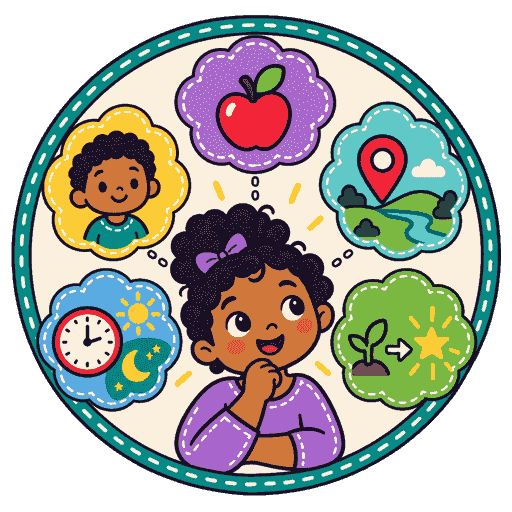
 Whoa person
 Whata thing
 Wherea place
 Whena time
 Whya reason
 Howa way of doing it
Every question word is asking for one kind of answer.
WHO wants a person. WHAT wants a thing. WHERE wants a place.
WHEN wants a time. WHY wants a reason. HOW wants the way you did it.
Point to the picture that matches before you answer.
- Who is at the door? - The mail carrier.
- Where is the cat? - Under the bed.
- When do we eat dinner? - At night.
- Why is she wearing a coat? - Because it is cold.
Watch for: A place for a "who" question, or "because" with nothing after it. That is a question-word problem, not a knowledge problem - and it is teachable.
What this skill is
WH-questions come in a developmental order that follows how abstract the answer is. "What" and "where" ask about visible, concrete things, so they come first. "Who" needs person categories. "Why" requires causal reasoning, "how" requires describing a process, and "when" requires a sense of time - which is exactly why it comes last. Every WH-word demands a particular kind of answer. Who wants a person, where wants a place, when wants a time, why wants a reason. This page is about that matching, which is a separate skill from answering the question: a child can know perfectly well that the dog is in the garden and still answer "where is the dog?" with "the dog" - because they have not worked out what the question word is asking for.
What to expect
A three-year-old asked "why did the boy cry?" may confidently answer "because" and stop, or give a "what" answer instead. That is normal. Watch for a child who answers a different question than the one asked - answering "where" when you asked "when" - which tells you the question form itself has not been sorted out yet.
Try this at home
When to refer
Put it into practice
Tap any item below to open it full screen, one at a time, so a child can answer without reading the answer first.
These activities are a starting point, not the practice itself. A structured task is a good way to introduce a form and to find out whether a child has it yet. What actually moves it into everyday speech is using it in the real world and in ordinary play — which means the four things below matter more than finishing the list.
Recast
Say their sentence back correctly, without asking them to repeat it. Child: “he goed.” You: “he went! Where did he go?”
Expand
Add one or two words to what they said and hand it back. Child: “big truck.” You: “a big red truck!”
Simplify what you ask
Cut a long instruction into single steps and say them in the order they happen, rather than repeating the long one louder.
Follow their lead
Use whatever they are already playing with. A form practiced on something they chose is the one that shows up again tomorrow.
What Kind of Answer?
10 itemsSay what kind of thing each question is asking for. Tap any item to open it full screen.
What: One Sentence
10 itemsRead the sentence, then ask the question. The answer is right there in the sentence. Tap any item to open it full screen.
What: Two Sentences
10 itemsRead both sentences, then ask. The answer is in one of them - the other is there to hold in mind. Tap any item to open it full screen.
What: Three Sentences
10 itemsRead all three, then ask. The answer is not said outright: the child has to put the clues together. Tap any item to open it full screen.
Where: One Sentence
10 itemsRead the sentence, then ask the question. The answer is right there in the sentence. Tap any item to open it full screen.
Where: Two Sentences
10 itemsRead both sentences, then ask. The answer is in one of them - the other is there to hold in mind. Tap any item to open it full screen.
Where: Three Sentences
10 itemsRead all three, then ask. The answer is not said outright: the child has to put the clues together. Tap any item to open it full screen.
Who: One Sentence
10 itemsRead the sentence, then ask the question. The answer is right there in the sentence. Tap any item to open it full screen.
Who: Two Sentences
10 itemsRead both sentences, then ask. The answer is in one of them - the other is there to hold in mind. Tap any item to open it full screen.
Who: Three Sentences
10 itemsRead all three, then ask. The answer is not said outright: the child has to put the clues together. Tap any item to open it full screen.
When: One Sentence
10 itemsRead the sentence, then ask the question. The answer is right there in the sentence. Tap any item to open it full screen.
When: Two Sentences
10 itemsRead both sentences, then ask. The answer is in one of them - the other is there to hold in mind. Tap any item to open it full screen.
When: Three Sentences
10 itemsRead all three, then ask. The answer is not said outright: the child has to put the clues together. Tap any item to open it full screen.
Why: One Sentence
10 itemsRead the sentence, then ask the question. The answer is right there in the sentence. Tap any item to open it full screen.
Why: Two Sentences
10 itemsRead both sentences, then ask. The answer is in one of them - the other is there to hold in mind. Tap any item to open it full screen.
Why: Three Sentences
10 itemsRead all three, then ask. The answer is not said outright: the child has to put the clues together. Tap any item to open it full screen.
How: One Sentence
10 itemsRead the sentence, then ask the question. The answer is right there in the sentence. Tap any item to open it full screen.
How: Two Sentences
10 itemsRead both sentences, then ask. The answer is in one of them - the other is there to hold in mind. Tap any item to open it full screen.
How: Three Sentences
10 itemsRead all three, then ask. The answer is not said outright: the child has to put the clues together. Tap any item to open it full screen.
Story: The Lost Kitten
6 itemsRead the story once. Then ask the questions one at a time - the story stays on screen. Tap any item to open it full screen.
On Saturday morning, Nora heard a small sound coming from under the porch. She knelt down and saw a gray kitten with one white paw, curled up against the cold. Nora ran inside for a towel and a bowl of milk. The kitten was too frightened to come out at first, so Nora sat very still and waited nearly an hour. By lunchtime the kitten was asleep in her lap, and her mother had already agreed they could keep it if nobody claimed it.
Story: The Science Fair
6 itemsRead the story once. Then ask the questions one at a time - the story stays on screen. Tap any item to open it full screen.

Marcus had two weeks to build his project, but he spent the first week deciding what to do. Finally he chose to test which paper towel soaked up the most water. He bought three brands, poured the same amount of water into three dishes, and timed how long each towel took. The cheapest brand did the best, which surprised everybody including Marcus. He came second at the fair, behind a girl who had grown crystals in a jar.
Story: The Storm
6 itemsRead the story once. Then ask the questions one at a time - the story stays on screen. Tap any item to open it full screen.

The wind started in the afternoon and by dinner the power was out. Dad found the camping lantern in the garage and they ate cold sandwiches around the kitchen table. Jonah thought it was the best dinner he had ever had. His little sister did not agree and cried until Dad let her hold the lantern. The lights came back on just before bedtime, and the first thing everyone heard was the television, still on from hours before.
Story: The New Bus Driver
5 itemsRead the story once. Then ask the questions one at a time - the story stays on screen. Tap any item to open it full screen.

For three years the bus had been driven by Mr Okafor, who knew every child by name and kept a jar of stickers by his seat. When he retired in October, a new driver named Ms Patel took over. Nobody liked her at first because she would not let anyone stand up while the bus was moving. By December, though, she had learned all the names too, and there was a new jar by the seat with dinosaur stickers in it.
Story: The Library Card
6 itemsRead the story once. Then ask the questions one at a time - the story stays on screen. Tap any item to open it full screen.

Amira had wanted her own library card since she was five, but the rule was that you had to be able to write your whole name. She practiced on the back of receipts all summer. In August she walked to the library with her grandfather, wrote A-M-I-R-A B-E-G-U-M on the form, and the librarian slid a card across the counter. Amira checked out six books, which was the limit, and carried them home in both arms.
Describe the picture
105 questionsPick a picture, then answer the question about it. Point to the answer in the picture first if that helps. Tap a picture to start.